Umbraco 17 is here.
Here’s why it matters.
Released in November 2025, Umbraco 17 is the new Long-Term Support (LTS) baseline for serious digital platforms. It's supported through to 2028. If you're still on version 13 – or earlier – now is the time to plan.

Upgrade Paths
Direct upgrade path

Automated database migrations are included, though custom backoffice extensions will need to be rebuilt using the new Web Component architecture.
Stepped upgrade
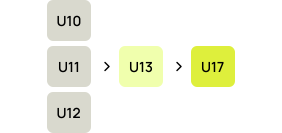
You should first upgrade to Umbraco 13 LTS, stabilise the site, and then move to Umbraco 17.
Legacy stepped upgrade
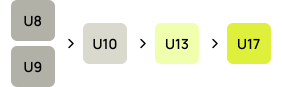
These require a more significant effort. It is often recommended to upgrade to U10, then U13, then U17, or perform a "content-only" migration if the legacy code is too heavily customised.
Umbraco 17 isn't about novelty. It's about maturity.

A backoffice that's fully grown up
The modern backoffice – codenamed 'Bellissima' – is no longer experimental. AngularJS is gone. Web Components and TypeScript are in. Faster to load, easier to extend, accessible by default. Your editors will notice immediately.

The rich text editor you've been waiting for
TinyMCE is out. Tiptap is in. Cleaner HTML output, better licensing compliance, and a more stable foundation for content teams who live in the editor day to day.

Load balancing for the backoffice
For the first time, the Umbraco backoffice can be load-balanced across multiple servers. For large editorial teams, that means no more bottlenecks. For your infrastructure team, that means better resilience.

Content tools that make sense
Legacy editors – Nested Content, Grid Layout – are retired. Block Grid and Block List take their place, giving editors a consistent and future-proof way to build pages.

Proper UTC date handling
All system dates and scheduled publishing now use UTC by default. If you're running sites for global audiences, you'll know exactly why this matters.

Block-level language variations
Multilingual content management is now more granular. Editors can manage translations at the block level, not just the page. More control, less duplication.
Should I upgrade now?
From version 13, Umbraco handles database migrations automatically. The work is in your custom backoffice extensions – anything built on AngularJS needs to be rebuilt using the new Web Component architecture. Depending on how customised your current solution is, that scope varies.
We scope it properly before we start. No surprises.
Don’t leave your upgrade to the last minute
Umbraco 13 end-of-life is December 2026. That's sooner than it sounds. We can scope your upgrade, map the migration path, and get you onto a stable, modern platform – without disrupting what you're running today.